



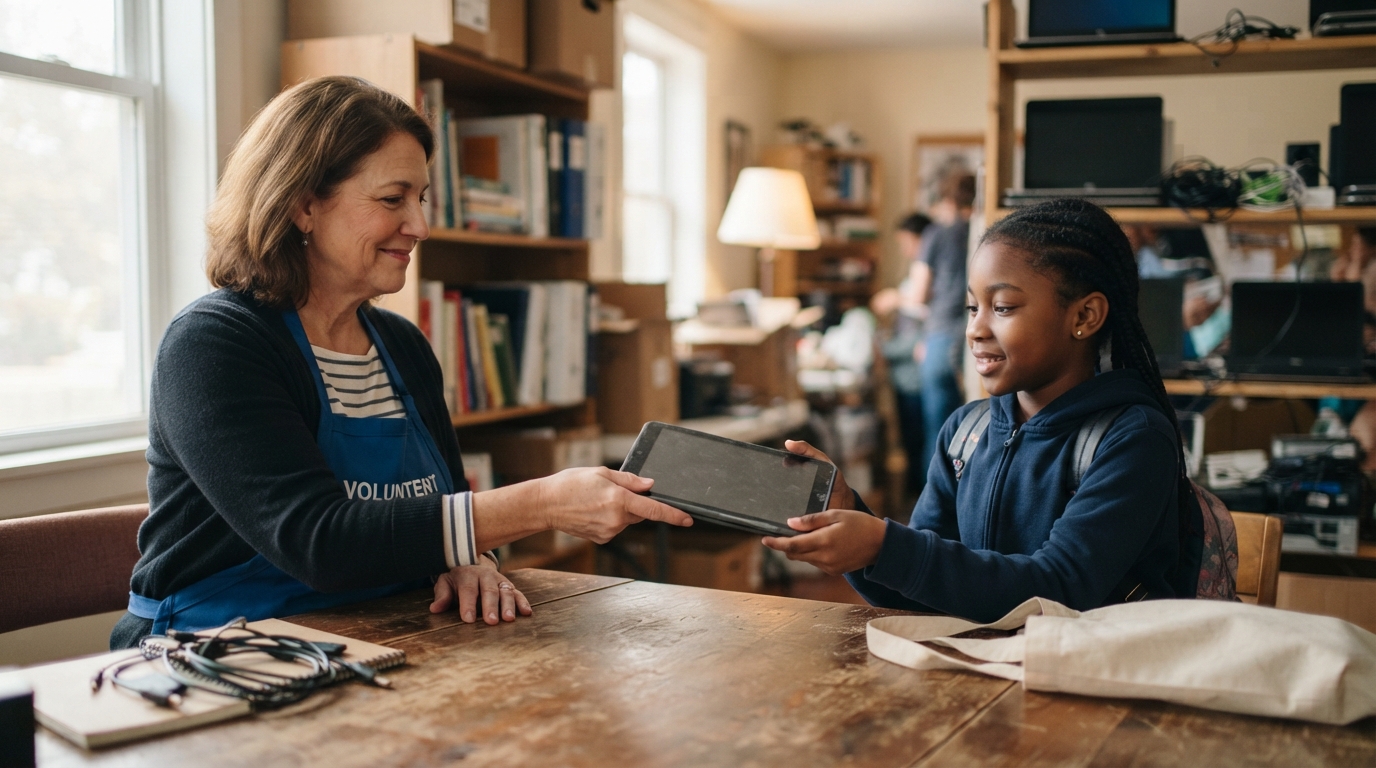
Short answer:
• Donating a working tablet to a verified charitable organization supports digital learning access for underserved students and families.
• Check that the device is in working condition, reset to factory settings, and handed over with its charger where possible.
• Choose a registered nonprofit with a transparent collection and distribution process to ensure the device reaches a genuine need.
A used tablet sitting idle in a drawer can still carry real value once it reaches a student or household without reliable access to a digital device. Across India, digital learning gaps remain a persistent barrier for children and young learners in low-income communities, and a functioning device can directly support schoolwork, skill-building, or access to online resources. Choosing to donate tablet devices through a verified channel ensures the contribution is directed toward an actual educational or community need rather than left unused. You can find out how the process works on the Ratna Nidhi Official Website.
Donating electronics responsibly also reduces the environmental burden of discarded devices. According to the United Nations Institute for training and research, electronic waste is one of the fastest-growing waste streams globally, which makes reuse through donation a practical alternative to disposal.
Why Tablet Donations Matter for Education Access
A tablet is often the difference between a student participating in digital classrooms and being left out entirely. Many government and nonprofit education programs in India now rely on digital tools for lessons, assessments, and skill training.
• Supports continuity of learning for students without a personal device at home
• Reduces electronic waste by extending a device’s usable life
• Provides practical access to study material, video lessons, and basic digital literacy tools
Donated tablets are particularly useful in community learning centers, shelters, and outreach programs where shared devices are used by multiple children or families.
Preparing a Tablet for Donation
A device that works reliably is more useful to a recipient than one that requires repair before it can be used. A short preparation routine also protects the donor’s personal data.
1. Back up and remove all personal files, photos, and accounts from the device.
2. Perform a factory reset so no previous data remains accessible.
3. Check the battery holds charge and the screen, ports, and buttons function normally.
4. Include the charger and any working accessories, since many recipients do not have spares.
5. Wipe the device physically clean before handing it over.
Devices that are visibly damaged beyond basic use are generally not suitable for donation and may need responsible e-waste recycling instead.
Choosing a Credible Organization
Not every collection drive or informal donation point has a transparent process for how devices are distributed. It helps to verify a few details before handing over a tablet.
| Factor | What to Check |
| Registration | Confirm the organization is a registered trust or nonprofit |
| Transparency | Look for a stated process on how donated devices are used |
| Focus area | Check whether education or digital access is a stated program area |
| Accessibility | Confirm whether drop-off, pickup, or mail-in options are available |
Ratna Nidhi Charitable Trust is listed as a trust operating in India with a stated focus on causes including education-related support. Reviewing an organization’s public profile before donating helps confirm it is an established, locally operating entity rather than an informal collection point.
Practical Considerations Before Donating
A few additional checks make the donation process smoother for both the donor and the receiving organization.
• Confirm whether the organization accepts tablets specifically, since some drives are limited to books or other items.
• Ask whether a receipt or acknowledgment is provided, which may be useful for personal records.
• Check if there is a minimum condition requirement, such as a working screen or functional charging port.
• Clarify whether the device should be dropped off or if a collection option is available.
These steps reduce the chance of a device being rejected or left unused after donation.
Frequently Asked Questions
What condition should a tablet be in to donate it? A donated tablet should power on, hold a charge, and have a functioning screen and ports. Devices with major physical damage are usually not suitable unless the recipient organization explicitly accepts them for parts or recycling.
Should personal data be removed before donating a tablet? Yes. A factory reset and removal of accounts, photos, and files is a necessary step before handing over any device, regardless of the receiving organization.
Can old or outdated tablets still be useful for donation? Older tablets can still support basic tasks such as reading, video lessons, or simple applications, provided they function reliably and are not significantly outdated for current software needs.
Is a tablet donation the same as e-waste recycling? No. Donation is intended for devices that still work and can be reused, while e-waste recycling is meant for devices that are no longer functional.
Business Information
Contact and location details for Ratna Nidhi Charitable Trust are published through its verified Google Business Profile listing for India.
Published service-area and contact details are listed via Ratna Nidhi Charitable Trust on Google Maps.

 Alexander Martin