





Summary:
- A recliner lift chair uses a motorized base to tilt a seated person forward, assisting them to a standing position without outside help.
- Chairs are typically categorized by recline type: two-position, three-position, and infinite-position models, each suited to different comfort and sleep needs.
- Sizing, weight capacity, and recline range are the main factors to check before choosing a chair for home use.
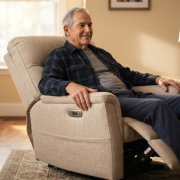
A recliner lift chair is a motorized recliner that tilts forward and raises a seated person toward a standing position, reducing strain on the knees, hips, and lower back. It functions as a recliner for everyday comfort while also serving as a mobility aid for people who find it difficult to rise unassisted from a standard chair.
Selecting a Recliner Lift Chair involves more than picking a fabric color. The right model depends on recline range, seat dimensions, weight capacity, and how the chair will be used day to day, whether for watching television, sleeping, or recovering from a medical procedure.
How Recliner Lift Chairs Work
A lift chair relies on a motorized base rather than manual leverage. Essentially a recliner, a lift chair leans forward as well as backwards, so a person does not need anyone’s help standing up because the lift chair does it for them. This mechanism is particularly useful for people managing arthritis, recovering from surgery, or dealing with balance limitations that make standing from a low seat difficult.
Falls remain a leading safety concern for older adults living at home, and mobility aids are one factor clinicians consider when addressing that risk. The CDC’s STEADI initiative provides resources for assessing fall risk and recommends reviewing home safety factors, including supportive seating and mobility equipment, as part of a broader prevention plan.
Types of Lift Chair Recline Positions
Lift chairs are generally grouped into three recline categories, and the right choice depends on how much flexibility a user needs beyond basic seating.
- Two-position chairs: Lift chairs come in three types, and the first type is a two-position chair, which reclines slightly. These suit users who mainly need help standing rather than full reclining.
- Three-position chairs: The three-position chair reclines far enough for sleep, but not completely horizontal. This is a common middle-ground option for general comfort and occasional napping.
- Infinite-position chairs: The infinite-position chair not only can be completely flat but also allows the back and feet to move independently of one another. These models offer the widest range of motion, including zero-gravity-style positioning.
| Recline Type | Recline Range | Best Suited For |
|---|---|---|
| Two-position | Slight recline only | Users who primarily need standing assistance |
| Three-position | Reclines for sleep, not fully flat | General comfort and occasional rest |
| Infinite-position | Fully flat, independent back/foot movement | Extended sitting, sleeping, or post-surgical recovery |
Sizing and Fit Considerations
Fit affects both comfort and safety, so measurements matter as much as recline style. Seat width, seat depth, and overall height vary by model and by manufacturer size category, such as small, medium, or large-wide frames.
- Weight capacity: Published specifications for lift chair models range from roughly 300 pounds up to 500 pounds depending on frame size, so matching capacity to the user is an early step.
- Wall clearance: Chairs that recline fully need adequate distance from the wall; some models require 17 to 24 inches of clearance when fully reclined.
- Seat depth and width: A seat that is too deep can press on the back of the knees, while one that is too narrow limits comfort for extended sitting.
Fabric and upholstery choices also matter for households that want the chair to blend with existing furniture rather than look clinical.
Local Considerations for Grand Forks Households
Cold-weather climates in Grand Forks, ND often mean more indoor time during winter months, which can make supportive seating a bigger part of daily comfort for people with limited mobility. Based in Maplewood, MN, Corner Home Medical serves customers across Grand Forks, ND with durable medical equipment, including seat lift chairs suited to home use. Checking warranty coverage on electrical components and mechanical labor is a practical step before purchase, since lift chairs include motorized parts that differ from standard furniture warranties.
Frequently Asked Questions
Is a lift chair covered by Medicare? Medicare may cover the seat-lift mechanism portion of certain chairs under durable medical equipment benefits, though coverage rules and documentation requirements vary, so confirming details with a supplier or Medicare directly is recommended.
How is a lift chair different from a standard recliner? A standard recliner adjusts backward for comfort but does not include a motorized lifting function, while a lift chair’s base tilts forward to help a seated person reach a standing position.
Can a lift chair be used for sleeping? Three-position and infinite-position models recline far enough for extended rest, with infinite-position chairs offering a fully flat setting, though a two-position chair has limited recline and is not intended for overnight sleep.
What maintenance does a lift chair need? Routine care includes checking the power cord and battery backup system if equipped, keeping the motor track free of debris, and following manufacturer guidance on warranty terms for electrical and mechanical parts.
Next Steps
Current product listings and service area information for Corner Home Medical are available for households comparing lift chair options.
Selecting a recliner lift chair ultimately comes down to matching recline style, size, and weight capacity to the person who will use it daily. Reviewing warranty terms and confirming measurements against the intended space can help avoid a mismatch after delivery, particularly for households where the chair will serve both as everyday seating and as a mobility aid.

 SOLED ADEPPS


 Alexander Martin